
Home / Asset classes / Metals & mining
Metals & mining
From underground wealth to programmable capital.
Independently validated mineral reserves can represent substantial latent economic value, but that value is difficult to mobilise. The financing available against it is often slow, dilutive or expensive, and how reserves are recognised in financial statements depends on the reporting framework, the stage of the project and the accounting policy applied. This is Tokenbridge’s flagship vertical.
The capital problem
Why validated reserves stay dormant.
None of these constraints are caused by a lack of value in the ground. They are caused by the shape of the financing available against it.
Long cycles
Development timelines restrict the return profiles most capital pools can accept.
Heavy capital expenditure
Upfront infrastructure and equipment funding requirements stall growth at the point of highest need.
Equity dilution
Early-stage share issuance transfers value away from the originator permanently.
Cost of debt
Legacy credit facilities price long-term operational margin out of the project.
Illiquid ownership
Proven reserves sit on the balance sheet without a mechanism to mobilise them.
Limited access
Mid-tier and specialist capital pools are structurally excluded from primary reserve exposure.
Geographic asymmetry
Jurisdictional risk perception creates financing barriers unrelated to asset quality.
Price cyclicality
Spot market downswings close financing windows regardless of reserve position.
Coverage
Four metal groups.
Precious metals
Gold, silver, platinum and palladium. Reserve assets and inflation hedges; the most straightforward candidates for direct asset backing.
Industrial metals
Copper, zinc, aluminium and iron ore. Financing tied directly to grid expansion, construction and urbanisation demand.
Battery & critical minerals
Lithium, nickel, cobalt, graphite and manganese. Energy transition and grid-scale storage supply chains.
Strategic minerals
Rare earths, chromium, molybdenum, vanadium and titanium. Strategically constrained supply with national security relevance.
The architecture
- 01Validated metal reserves
- 02Independent certification
- 03Legal / SPV structure
- 04RWA tokenization
- 05Institutional capital
- 06Liquidity generation
- 07Mine development & expansion
- 08Digital financial utilisation
Resource verification relies on an internationally recognised reporting code — for example NI 43-101, JORC or SAMREC, and others accepted under the CRIRSCO family or applicable locally — prior to any capital deployment. Which code applies depends on the jurisdiction, the commodity and the market on which the owner reports.
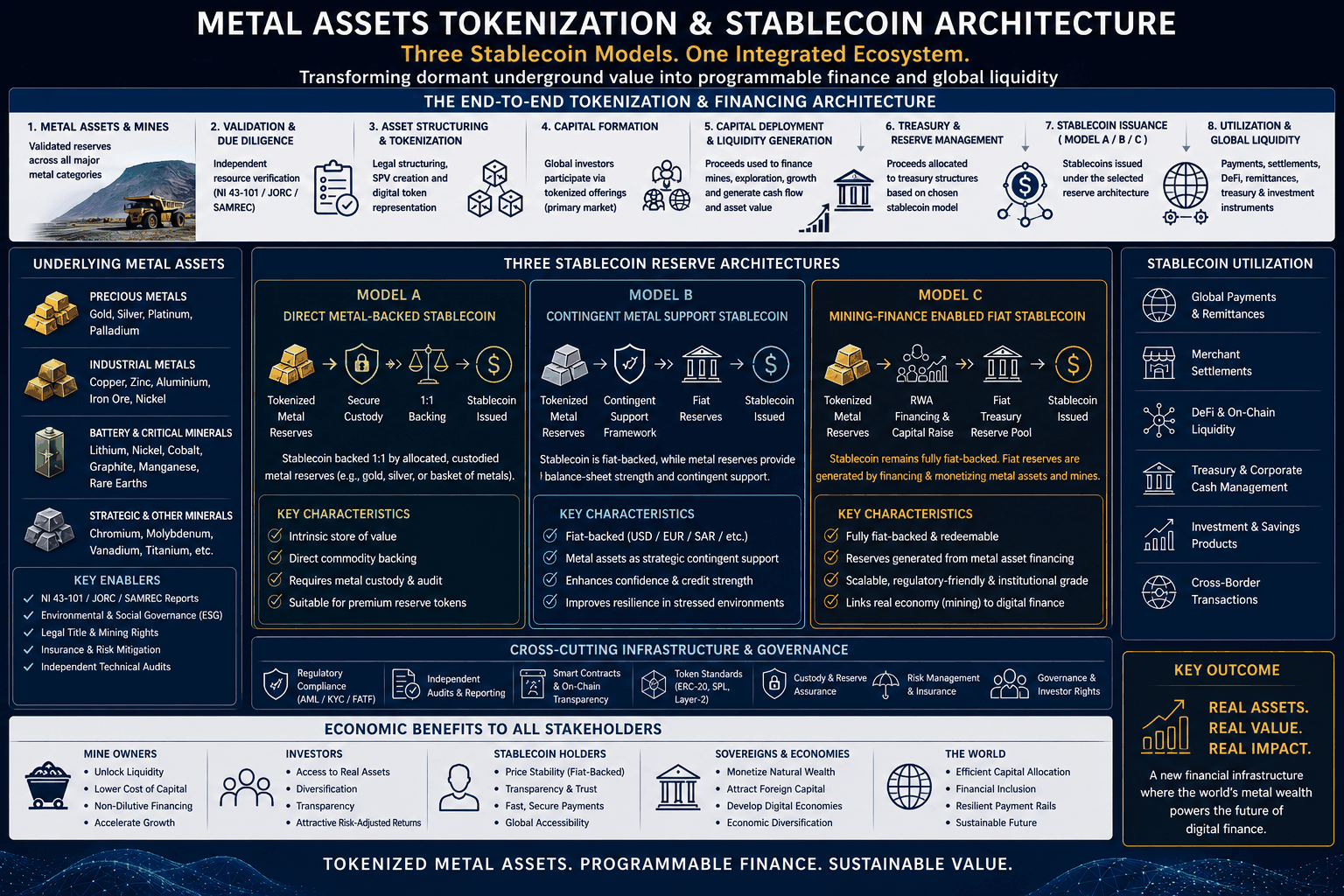
Reference architecture
Metal asset tokenization and the three stablecoin models.
How validated reserves connect through structuring and capital formation to treasury and settlement infrastructure.
What is financed
Instruments used in this vertical.
- SPV equity or share tokens
Direct or indirect participation in the vehicle holding the mining right or reserve position.
- Secured notes
Debt instruments secured on the asset, on offtake receivables or on the shares of the vehicle.
- Royalty instruments
A defined percentage of revenue or production for a defined term, paid from first production.
- Streaming structures
Upfront capital against the right to purchase a share of future output at a pre-agreed price.
- Development convertibles
Capital for exploration or expansion converting at defined operational milestones.
Tokenization is not merely blockchain. It upgrades a corporate structure into an automated market ledger.
Programmable finance platform- Programmable financing & ownership
Disbursement schedules that release capital against verified operational milestones, and fractional ownership boundaries enforced at the instrument level.
- Programmable collateral
Real-asset claims that can be routed into credit mechanisms without manual settlement delay, subject to the applicable legal framework and to the authorisations of the parties involved.
- Revenue participation
Production upside or royalty distributions streamed to eligible holders on a defined schedule.
Tokenbridge structures and coordinates. Regulated functions are performed by authorised partners.
Descriptions of capability on this page describe the group’s target operating model, not authorisations held. Regulated issuance, distribution, custody, administration, trading-venue and payment functions are carried out by entities or partners holding the relevant authorisations in the relevant jurisdiction. We will describe any authorisation only once it is actually held.
Discuss a reserve position or a mine financing.
We work with mine owners, sovereign resource holders and their advisers from pre-certification through to institutional placement.